

A Mind Map is a valuable tool for organizing information relevant to your role within a team. Teamwork can be challenging to incorporate into your daily workload, especially when juggling random emails, attending meetings, and completing tasks on time. For some, participating in teamwork feels like “other duties as required,” while for others, it is a core aspect of their daily responsibilities. The main challenge lies in effectively managing your time while collaborating with a team and keeping your information organized to enhance productivity. Let’s explore a template to help you maximize your teamwork experiences.
Figure 1 is a template for organizing ideas, notes, and responsibilities when serving on a team.
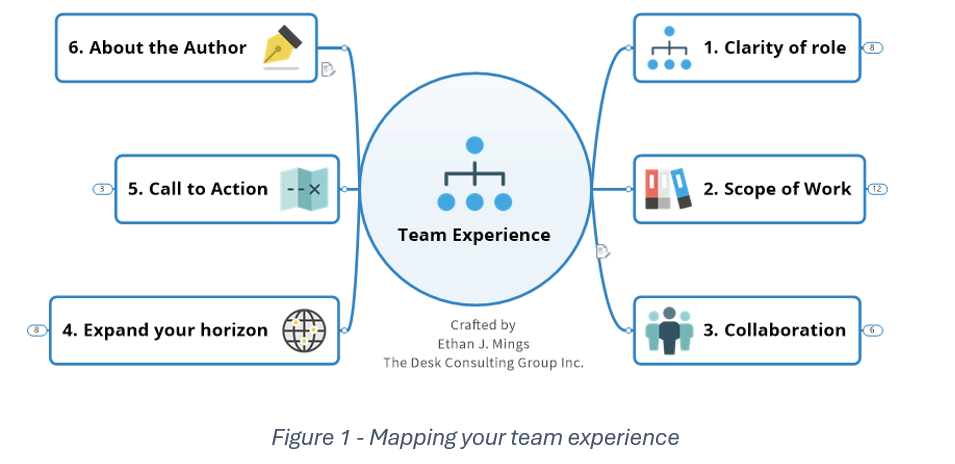
Clarity of the Role is an opportunity to clarify your role on the team. Identify if your role is to a) lead the team, b) follow and play a role, or c) support the team. Each role is essential, and it is helpful to clarify your role. Leadership requires careful attention to the purpose of the team’s work and how the team can work together to achieve the results. Follow is the ability to listen to the leaders, work with the team on results and be responsible for carrying out your teamwork promptly. Support consists of the skills required to enable the team to succeed. All the roles are essential; in some cases, you switch roles depending on the complexity and length of a team project.
Tip: Link a document to your map that outlines what your team is being asked to accomplish.
Scope of Work is important in a team setting. Learn about the team’s purpose by reading or creating a team charter. The Charter quickly captures essential details about the team members, results, and overall plans.Getting the facts will help you make your contribution to the team. As a team leader, follower or support person, explore how you make the most of your role on the team.
Tip: Use the notes features in a map to capture critical points, then attach essential documents to the map for easy access.
Collaboration is critical to the overall success of being a team member or leader. Effective collaboration requires careful attention to healthy conflict and the ability to reach a consensus. Exploring and developing a shared definition of healthy conflict and consensus on a team is helpful. Clarifying both topics will open the door to meaningful conversation and the ability to find solutions to complex problems. Other considerations include how the team will make decisions and what communication tools (e.g., Slack, Teams, etc.) will help everyone stay on track.
Tip: Explore different definitions of conflict, consensus, decision, and communication tools. Add the answers to the notes section and then put links in the map for the tools you will use.
Expanding your horizons is an opportunity to consider how being on a team can help you with your personal growth. You can consider some questions about new skills to learn, practice, or explore, building relationships with new people, and looking to the future because of your team. Use the space for self-reflection, planning and note-taking to maximize your team experience.
Tip: Check your career pathway and see where the teamwork will help you move towards your future. It would be best to link your career path map so you can quickly reference the mind map.
Call to Action is an opportunity to build a map to support your next team project. Click here to see the entire map. Build the map using your favourite Mind Mapping application (e.g., Mindomo, MindManager, etc.). Pick a team you are involved in at present. Start filling in the branches with as much information as you can. Reflect on the overall map to see how your work on the team is helping you expand your horizons.
Mind mapping your team experience is one way to organize your thoughts on one page. It enables you to clarify your role, define the scope of work, define collaboration and understand how team experience can expand your career horizons.

Jerry Mings is a professional group process consultant with extensive experience in the health and social sectors. He brings a deep understanding of facilitating groups to address problems, explore opportunities, and tackle important questions. Additionally, he is a creative problem-solver with exceptional interpersonal and communication skills. Jerry resides in Oakville, Ontario.
 D&J Career Pathways
Leave a comment